
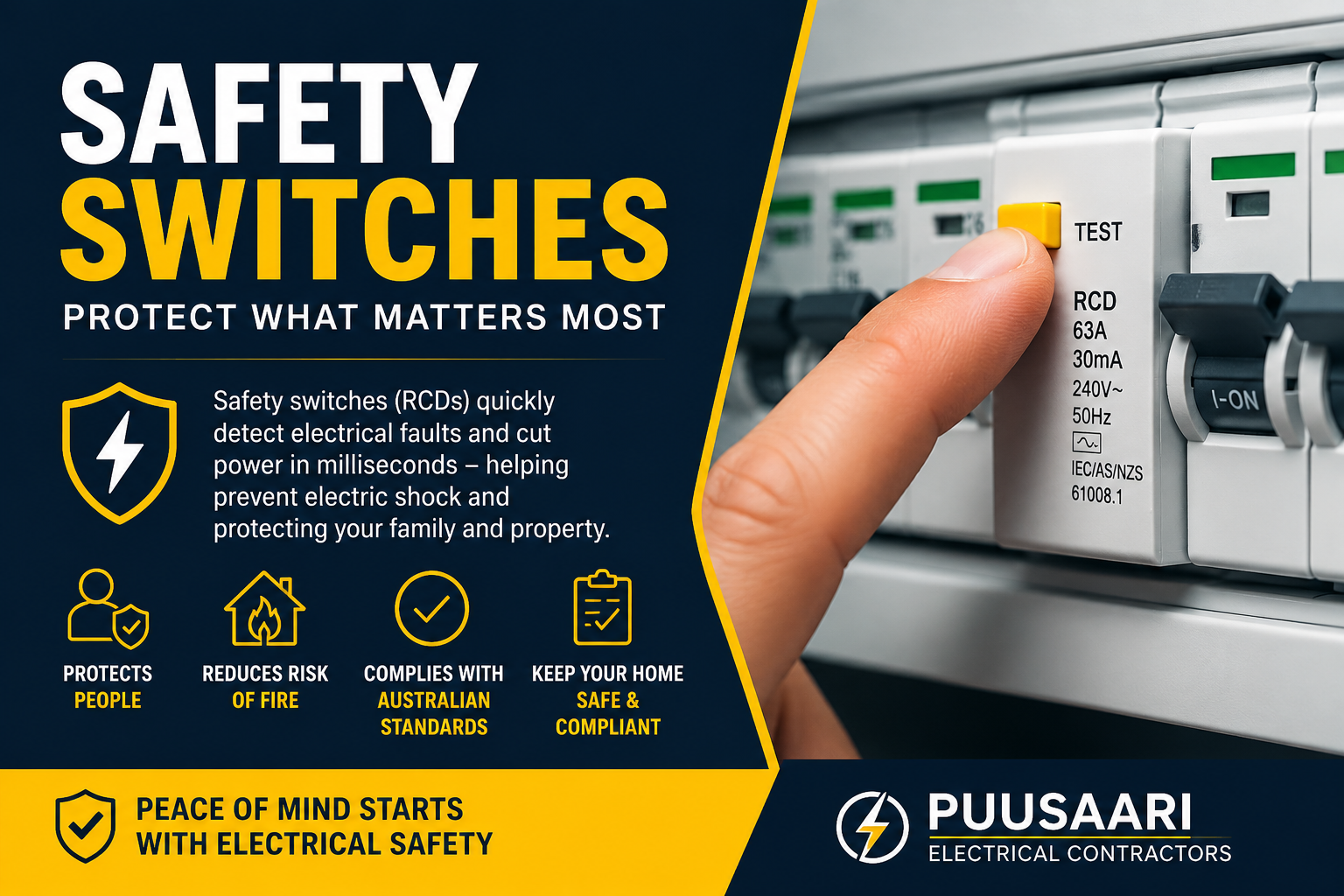
Safety Switches – Why They Are Essential for Every Home and Business
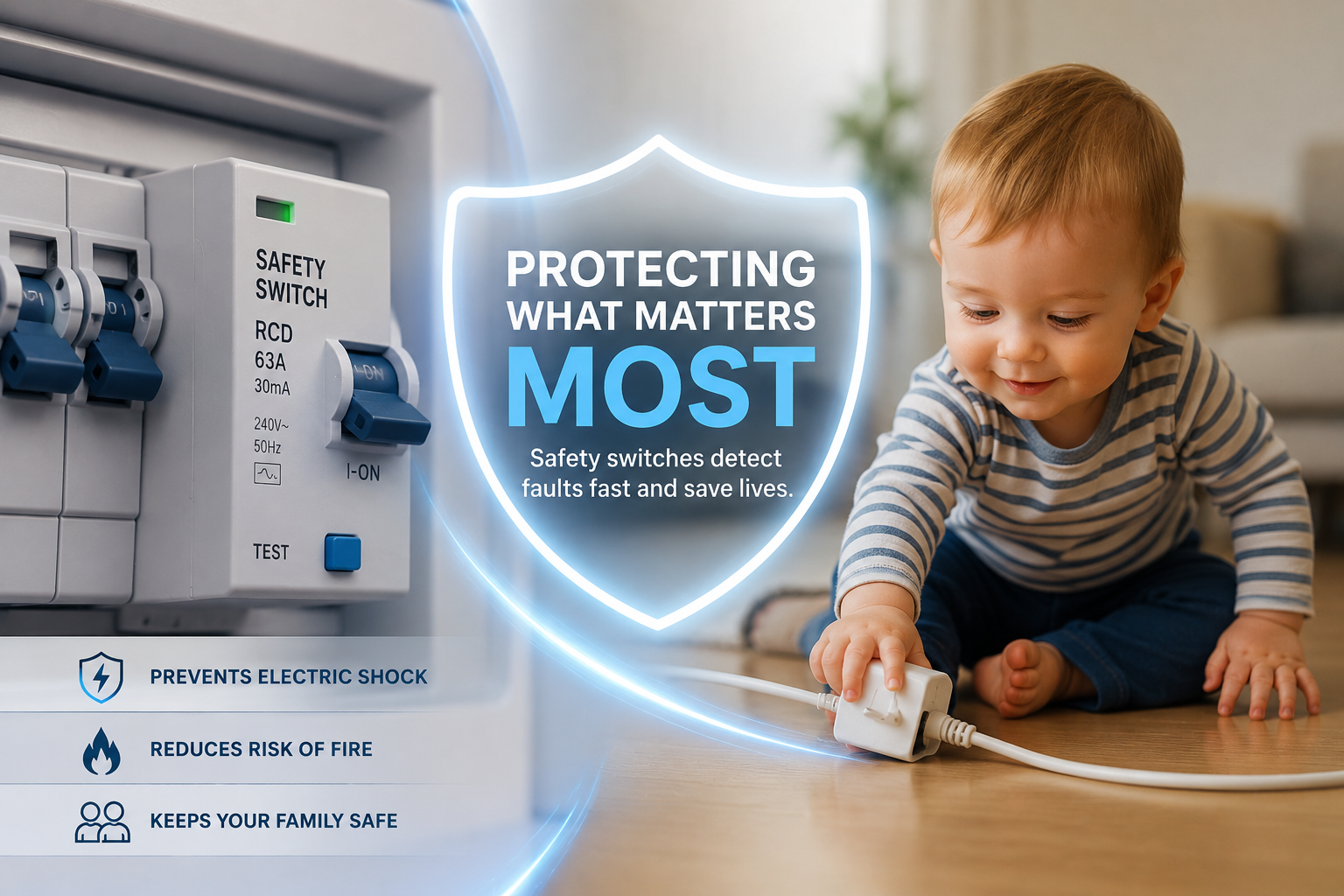
What Is a Safety Switch?
A safety switch is a fast-acting electrical protection device that constantly monitors the flow of electricity through a circuit. If it detects electricity leaking to earth — such as through a person who has accidentally come into contact with a live electrical component — it will disconnect the power almost instantly.
Unlike a standard circuit breaker or fuse, which is designed primarily to protect wiring from overload or short circuits, a safety switch is specifically designed to protect people from electric shock.
In many cases, a safety switch can disconnect power in as little as 0.03 seconds.
Why Are Safety Switches Important?
Safety switches play a critical role in protecting your family, staff, tenants, and property from:
Electric shock and electrocution
Electrical fires
Faulty appliances and damaged wiring
Accidental contact with live electrical parts
Faults caused by moisture or deteriorated insulation
Electrical faults can occur without warning. Damaged extension leads, faulty appliances, rodents damaging cables, deteriorated wiring, or water ingress can all create dangerous situations.
A properly installed and functioning safety switch can mean the difference between a minor inconvenience and a serious injury or fatality.
Legal Requirements in Queensland
Queensland has some of the strictest electrical safety laws in Australia regarding safety switches.
Under Queensland legislation:
All new homes must have safety switch protection on all final subcircuits.
Any new power circuit or lighting circuit installed must be protected by a safety switch.
When significant electrical work is carried out on an existing installation, upgrades may be required to bring parts of the installation closer to current standards.
Since 2000, all new homes built in Queensland have required safety switches on power circuits.
Since 2008, all new homes have required safety switch protection on lighting circuits as well.
For rental properties:
Queensland law requires prescribed safety switches to be installed on power point circuits and lighting circuits where required by legislation.
Landlords and property owners have a legal responsibility to ensure electrical installations are safe.
Australian Standards and Compliance
Safety switch installations must comply with several Australian Standards and regulations, including:
AS/NZS 3000:2018 – Wiring Rules
This is the primary electrical installation standard in Australia and New Zealand. It outlines the requirements for:
RCD protection
Circuit protection
Installation methods
Testing and verification
Electrical safety requirements
The current Wiring Rules require RCD protection for final subcircuits supplying:
Socket outlets (power points)
Lighting circuits
Domestic and residential installations
Many commercial installations
Electrical Safety Regulation 2013 (Queensland)
Queensland’s Electrical Safety Regulation reinforces the requirement for safety switch protection in various installations and sets obligations for electrical safety compliance.
AS/NZS 3760
This standard covers the testing and tagging of electrical equipment and complements the protection provided by safety switches.
How Do I Know If My Home Has Safety Switches?
Many older homes still have:
Ceramic fuses
Old-style circuit breakers
Limited RCD protection
No protection on lighting circuits
Shared RCDs protecting multiple circuits
A modern switchboard should generally have clearly marked safety switches or RCBOs (combined circuit breaker and safety switch devices).
Some signs your switchboard may need upgrading include:
Flickering lights
Circuits tripping regularly
Old ceramic fuses
Lack of labelled circuits
No test buttons on breakers
Limited space for additional circuits
Burning smells or heat damage
The Importance of Regular Testing
Safety switches should be tested regularly to ensure they operate correctly.
Most manufacturers recommend pressing the “TEST” button every three months. This simulates a fault and confirms the mechanism is functioning.
If the safety switch fails to trip during testing, it should be inspected by a licensed electrician immediately.
Professional testing during routine electrical inspections is also recommended, particularly in:
Rental properties
Commercial buildings
Rural properties
Homes with older switchboards
Upgrading Older Switchboards
Many older switchboards were never designed to handle modern electrical demands such as:
Air conditioning systems
Pool equipment
EV chargers
Solar systems
Modern kitchen appliances
Upgrading your switchboard can:
Improve electrical safety
Bring your installation closer to current standards
Reduce nuisance tripping
Provide room for future expansion
Improve reliability and protection
At Puusaari Electrical, we can inspect your existing switchboard and advise on the most suitable upgrade options for your home or business.
Protect Your Family and Property
Safety switches are one of the most important electrical safety devices in any property. They provide critical protection against electric shock and electrical fires and are now a key requirement under Australian electrical standards and Queensland legislation.
If you are unsure whether your home or business is adequately protected, contact Puusaari Electrical for a professional inspection and advice.
Our experienced electricians can:
Test existing safety switches
Upgrade outdated switchboards
Install additional RCD protection
Ensure your installation complies with current standards
Provide practical solutions tailored to your property
Contact Puusaari Electrical Contractors Pty Ltd
For professional safety switch installation, testing, and switchboard upgrades, contact our team today.